

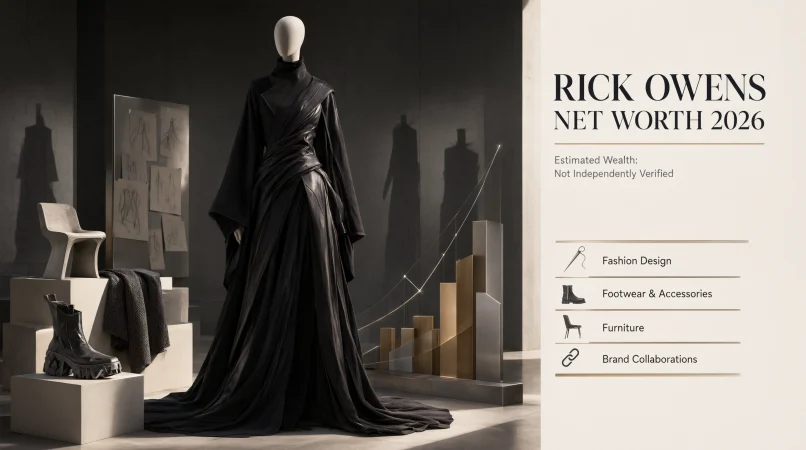
Rick Owens’ net worth in 2026 cannot be established from verified public financial records; his wealth is best assessed through his fashion business, reported ownership in Owenscorp, product sales, collaborations, and other design-related ventures rather than an unverified exact figure.
Rick Owens is one of the distinctive figures in contemporary luxury fashion. Recognized for dark color palettes, dramatic silhouettes, unconventional proportions, and sculptural design, he has built a career that extends beyond clothing into footwear, furniture, accessories, and creative collaborations.
Interest in Rick Owens net worth reflects more than curiosity about a fashion designer’s personal fortune. It also raises questions about how an independent luxury label generates revenue, how business ownership contributes to personal wealth, and why a recognizable designer’s commercial success cannot be translated directly into a reliable net worth figure.
Owens’ career offers a useful example of the relationship between creative influence and business ownership. His label has developed an international presence, while his work across different product categories has helped establish a recognizable design identity.
However, his personal financial statements, complete asset portfolio, liabilities, and the current valuation of his private business are not publicly verified. Any numerical estimate should therefore be treated cautiously rather than presented as a confirmed financial fact.
This article examines his background, business activities, potential income streams, achievements, assets, and financial outlook for 2026. It distinguishes established career information from assumptions about personal wealth and avoids assigning unsupported values to private assets.
Bio Data Table
| Field | Details |
|---|---|
| Full Name | Rick Owens |
| Date of Birth | November 18, 1961 |
| Age as of 2026 | 64, turning 65 in November |
| Place of Birth | Porterville, California, United States |
| Nationality | American |
| Height | Not publicly verified |
| Weight | Not publicly verified |
| Health Conditions | Not publicly verified |
| Religion | Not publicly verified |
| Education | Studied art at Otis College of Art and Design; later studied pattern-making at Los Angeles Trade-Technical College |
| Profession / Industry | Fashion designer, entrepreneur, furniture designer |
| Zodiac Sign | Scorpio |
| Marriage / Relationship Status | Married to Michèle Lamy |
| Children | Not publicly verified |
| Net Worth | No independently verified figure available for 2026 |
| Social Media Accounts | Official and verified account details should be checked directly before publication |
| Still Alive | Yes, based on publicly available biographical information |
| Famous For | Avant-garde luxury fashion, distinctive silhouettes, footwear, furniture, and the Rick Owens label |
The biographical details above are separate from the financial assessment. In particular, the absence of a verified net worth figure does not mean Owens lacks substantial wealth; it means that available information does not establish his personal balance sheet with sufficient confidence.
Who Is Rick Owens?
Rick Owens was born in Porterville, California, in 1961. His early education and creative interests eventually led him toward fashion, although his path was not limited to conventional fashion-school training.
He studied art at Otis College of Art and Design in Los Angeles before pursuing pattern-making at Los Angeles Trade-Technical College. This combination of artistic study and practical garment construction helped establish a foundation for his later approach to clothing.
Education and Early Career
Artistic thinking and technical garment skills serve different purposes in fashion. Art can influence a designer’s approach to form, proportion, material, and presentation, while pattern-making translates those ideas into garments that can be produced and worn. Owens’ career brought these elements together through designs that often challenge conventional silhouettes.
Before establishing his own label, Owens worked in the Los Angeles garment industry. This period provided experience with the practical side of fashion production, including garment construction and development. Such experience can be important for designers who eventually operate their own businesses because creative ideas must be translated into products that can be manufactured and sold.
Launching the Rick Owens Brand
Owens launched his eponymous fashion label in 1994. His early work helped establish the aesthetic that would become central to his reputation: muted colors, elongated proportions, leather garments, and a dark, sculptural visual language.
His career gained broader international attention after he presented his work in Paris. The move helped position the brand within the international luxury fashion market, where designers compete not only through product quality but also through originality, consistency, and cultural relevance.
Brand Expansion and Creative Partnerships
Over time, Owens developed collections for menswear and womenswear and expanded into footwear, accessories, furniture, and collaborations. These developments broadened the commercial scope of his work while preserving a recognizable creative direction.
His long-running partnership with Michèle Lamy has also been an important part of the public story of the business and its creative environment. However, the exact division of financial responsibilities, ownership rights, and personal assets between individuals should not be assumed without documentation.
Owens’ background demonstrates how a designer can turn a distinctive aesthetic into an internationally recognized brand. His financial position, however, depends on more than professional recognition. It also depends on the commercial performance of his company, the terms of ownership, and the money retained after operating costs and other obligations.
Rick Owens Net Worth Overview: 2026 Estimate
The most important question when evaluating Rick Owens’ net worth is how much of the value created by his fashion business belongs to him personally.
Some online celebrity-finance publications have placed his net worth at approximately $200 million. However, this figure is not independently confirmed by public financial statements, audited personal accounts, or a verified disclosure of his complete assets and liabilities.
For that reason, the $200 million figure should be treated as a published estimate, not a confirmed valuation. Publicly verified information is limited, and there is insufficient evidence to establish a reliable personal net worth range for 2026.
What supports the estimate?
Several aspects of Owens’ career provide context for why substantial wealth estimates circulate.
A long-running luxury label: Owens established his fashion business in 1994 and has maintained a recognizable presence in the international luxury market. A brand that sustains demand over decades can create considerable commercial value.
Business ownership: Owens’ relationship with Owenscorp is central to understanding his potential wealth. Ownership in a profitable private company can be more valuable than salary or design fees alone.
Multiple product categories: Clothing, footwear, accessories, furniture, and collaborations give the brand several ways to generate revenue. This diversification may reduce dependence on any single category, although the actual financial contribution of each remains undisclosed.
International distribution: The brand’s presence in international retail markets and its long-standing recognition within luxury fashion provide evidence of commercial reach. Distribution and brand recognition, however, do not reveal exact profits.
These factors help explain why high net worth estimates may appear plausible, but they do not establish a specific amount.
Revenue is not the same as personal wealth
Understanding fashion-business finances requires separating several concepts.
| Financial term | Meaning in Rick Owens’ context |
|---|---|
| Gross revenue | Total sales generated by the business before expenses |
| Business profit | Revenue remaining after applicable operating costs and expenses |
| Career earnings | Income accumulated through his work over time, before accounting for all personal obligations |
| Ownership income | Money received through distributions or other ownership-related arrangements |
| Business valuation | An estimate of what the company or its ownership interests may be worth |
| Personal net worth | Personal assets minus personal liabilities |
For example, a fashion company might generate substantial annual sales while spending heavily on materials, skilled production, staff, retail locations, distribution, and new collections. Its sales total cannot be treated as the owner’s personal income.
Similarly, a designer might hold valuable company equity without having the same amount available as cash. The value of that equity depends on profitability, liabilities, ownership percentages, and the price a buyer might be willing to pay.
Expenses that influence his actual wealth
Owens’ personal net worth may be affected by business expenses, taxes, personal spending, investments, debt, and the division of profits among owners.
Luxury fashion also involves costs that are not always obvious to customers. Complex construction, specialized materials, product development, quality control, and international logistics can all affect margins.
Without access to verified company accounts and personal financial records, it is impossible to calculate the final amount Owens has retained over his career.
Assessment for 2026: Rick Owens has established a successful international design business and is associated with substantial commercial activity. His exact net worth remains unverified, and any published dollar figure should be presented as an estimate rather than a fact.
Net Worth Growth Timeline
Owens’ financial development can be understood through three broad stages: his early work in fashion, the expansion of his own label, and the growth of a wider design business.
Before Fame: Education and Early Fashion Work
Before his label became internationally recognized, Owens studied art and developed practical skills in garment construction and pattern-making. He later worked in the Los Angeles fashion industry before launching his own brand.
During this stage, his financial position was likely more closely tied to professional work and the early development of his label than to a mature luxury business.
However, his income during these years is not publicly verified. There is no reliable annual earnings record that establishes how much he earned from employment, early collections, or initial sales.
The financial importance of this period lies in the skills and professional relationships he developed. Technical knowledge can help a designer manage product development, while industry connections can support manufacturing and retail distribution.
Breakthrough Phase: Building the Rick Owens Label
Owens launched his namesake label in 1994 and gradually developed a distinctive identity in contemporary fashion.
His first runway presentation in New York in 2001 and the CFDA award for emerging talent in 2002 were important professional milestones. His subsequent move to Paris in 2003 placed his work within a major international fashion environment.
The introduction of a furniture collection in 2005 and the opening of a Paris flagship store in 2006 demonstrated that the business was expanding beyond the original clothing operation.
Financially, this phase marked a transition from establishing a design career toward building a broader commercial enterprise. Recognition could support retailer interest, customer demand, and opportunities to enter new markets.
Nevertheless, awards, runway shows, and store openings are not direct measures of profit. The exact effect of these milestones on revenue and personal wealth remains unverified.
Peak and Recent Years: An International Design Business
As the label matured, its activities expanded across clothing, footwear, accessories, furniture, and collaborative projects. This broader portfolio allowed the business to reach different customer segments while maintaining a consistent creative direction.
Owens’ continued presence in the luxury market also helped preserve the recognition associated with his name.
At this stage, ownership and the performance of the company become particularly important to a net worth assessment. A designer who retains a significant interest in a successful business may accumulate wealth through the value of that ownership, even if personal salary figures are unavailable.
Still, current annual profits, owner distributions, personal investments, and the company’s 2026 valuation are not publicly verified. The recent period supports the conclusion that Owens has built a substantial professional enterprise, but it does not establish his precise net worth.
Main Sources of Income
Rick Owens’ potential income streams are closely related to luxury fashion, design, and business ownership. Each should be evaluated separately rather than combined into an unsupported personal wealth figure.
Core Profession Income: Fashion Design
Fashion design is the foundation of Owens’ career.
His collections include garments that are recognized for their distinctive proportions, draping, and use of materials. The commercial appeal of the label depends on more than the garments themselves: customers also buy into its design philosophy, reputation, and place within luxury culture.
Income may reach the designer through compensation, business distributions, or ownership-related arrangements. However, his current personal compensation and the exact division of earnings are not publicly verified.
Business Revenue and Company Ownership
Owenscorp is important because it connects the creative identity of the label with its commercial operations.
Owens has been described in industry coverage as retaining a significant ownership stake in the business. The exact current ownership percentages and complete shareholder arrangements should not be assumed without current documentation.
If a privately held company generates profits and retains them, its owners may benefit from increased business value. If the company distributes profits, owners may receive income directly. These are different ways in which ownership can contribute to wealth.
However, company revenue cannot be counted as personal earnings, and the company’s total valuation cannot automatically be assigned to Owens alone.
Footwear and Accessories
Footwear and accessories extend the brand beyond clothing. Products such as sneakers, boots, bags, and jewelry can attract customers who may not purchase more expensive runway garments.
These categories also allow a label to serve different buying occasions and price levels while maintaining its visual identity.
Their contribution to Owens’ personal wealth depends on sales, production costs, distribution arrangements, and the amount of profit retained by the company. Detailed category-level figures are not publicly verified.
Furniture and Interior Design
Owens’ furniture work represents a significant extension of his creative practice. The collection translates his interest in sculptural shapes and unconventional materials into objects for interiors.
Furniture may generate sales income and strengthen the wider design brand. Some pieces may also attract interest from collectors, galleries, and design institutions.
However, collectible value is not equivalent to cash income. The value of an individual object depends on its provenance, condition, market demand, and ownership. Owens’ personal earnings from furniture and the current value of his holdings are not publicly verified.
Brand Collaborations
Collaborations with established companies have introduced Owens’ design language to broader audiences.
Such partnerships can create commercial opportunities through product development, design fees, licensing arrangements, or revenue-sharing agreements. The actual structure varies by contract.
A successful collaboration can also improve visibility and create new customers for a designer’s own label. Nevertheless, the number of products sold does not reveal the amount paid to the designer, and the financial terms of Owens’ individual partnerships are not publicly verified.
Books and Creative Projects
Owens has published books documenting his design work and furniture. Exhibitions and other creative projects have also helped present his work to audiences outside conventional retail.
These activities may create publishing income, project fees, or other commercial opportunities. They also preserve the visibility of his work and contribute to his long-term professional reputation.
No verified public accounting establishes the amount he receives from these activities. They should be treated as relevant supplementary channels rather than assumed major contributors to his fortune.
Investments and Other Ownership Interests
His reported relationship with Owenscorp is the clearest business ownership interest associated with his financial profile.
Other investments, such as publicly traded securities, funds, or unrelated private companies, are not sufficiently documented to assign them a value. The same applies to any unverified property holdings or financial arrangements.
A credible estimate should not fill these gaps with assumptions. The value of his known business activities provides useful context, but a complete personal balance sheet is unavailable.
Business Strategy Behind the Wealth
Owens’ business strategy combines a recognizable design identity with a long-term approach to brand development. Rather than relying on frequent changes in fashion trends, his work has maintained recurring visual themes that customers can identify across collections.
A consistent creative identity
The Rick Owens label is associated with dark palettes, sculptural proportions, oversized shapes, and an unconventional interpretation of luxury. This consistency helps distinguish the brand in a crowded market.
A recognizable identity can support repeat purchases and customer loyalty. It may also make the brand attractive to retailers and collaboration partners looking for a distinct creative perspective.
The financial benefit is indirect: brand recognition can support demand, but it does not guarantee sales or profit.
Ownership and independence
Owens’ reported ownership in Owenscorp is central to understanding his potential long-term wealth. Maintaining an ownership stake can allow a founder to benefit if a company becomes more valuable over time.
Independence also gives a designer greater influence over creative decisions, product direction, and brand positioning. However, an independent company must manage its own operating costs and business risks rather than relying entirely on a larger parent organization.
The exact value of Owens’ equity cannot be established without current information about the company’s finances, liabilities, and ownership structure.
Selective expansion
The expansion into footwear, accessories, furniture, and collaborations allows the business to explore new markets without abandoning its core aesthetic.
This approach may diversify revenue, but each category comes with its own production requirements, customers, and cost structure. Furniture, for example, has different manufacturing and distribution needs from ready-to-wear clothing.
Long-term success depends on balancing creative experimentation with operational discipline.
Partnerships and production
Owens’ career has involved business partners and specialist production relationships. His official interviews have described the importance of partners who supported the brand’s development over time.
In luxury fashion, reliable production is essential. Skilled manufacturers, material suppliers, and commercial partners can help a designer maintain quality while serving an international customer base.
The terms of those relationships are not fully public, so their precise financial impact should not be estimated without evidence.
Long-term brand value
A designer’s name can become a commercial asset in its own right. It may support demand for products, collaborations, furniture, books, and future collections.
For Owens, long-term value depends on maintaining the connection between his distinctive creative vision and the commercial performance of the business. Continued recognition is valuable, but personal wealth ultimately depends on the financial results and ownership arrangements behind the brand.
Awards and Achievements and Financial Impact
Rick Owens’ career includes several documented professional achievements that strengthened his standing in the fashion industry.
- 2002 — CFDA Perry Ellis Award for Emerging Talent: This award recognized Owens’ growing influence in American fashion and helped raise his professional profile.
- 2007 — Cooper Hewitt National Design Award for Fashion Design: This recognition reflected his contribution to design and expanded his standing beyond a narrow fashion audience.
- 2017 — CFDA Geoffrey Beene Lifetime Achievement Award: The award recognized his sustained contribution to fashion over many years.
- 2019 — CFDA Menswear Designer of the Year: This honor reinforced his reputation in contemporary menswear.
- 2021 — WWD Honors Womenswear Designer of the Year: The recognition highlighted his work in womenswear and the continuing relevance of his design practice.
These achievements demonstrate professional recognition, not personal financial value.
Awards can help attract press attention, retailer interest, and collaboration opportunities. They can also reinforce customer confidence in a designer’s work. However, there is no verified calculation showing how much additional income or business value any individual award generated for Owens.
His broader achievement is the development of a recognizable international design business spanning several categories. That accomplishment provides a stronger basis for discussing his commercial position than using awards as a direct proxy for wealth.
Assets and Lifestyle
Owens’ work often incorporates sculptural furniture, distinctive materials, and dramatic interiors. His public design identity, however, should not be confused with a verified list of personal possessions.
Real Estate
Profiles of Owens have discussed his life and work in Paris and Venice. His professional activities have involved both residential and creative spaces, reflecting the close relationship between his design practice and personal environment.
Nevertheless, a complete, current property portfolio has not been independently verified. It is not possible to establish the present market value of his residences, the extent of his ownership interests, or any associated liabilities from the available information.
Even when a property is publicly associated with a designer, the owner, financing arrangements, and ownership structure may not be clear.
Cars and Luxury Purchases
There is no sufficiently verified inventory of Owens’ personal cars or their current values.
His association with luxury fashion does not establish that he owns particular vehicles, watches, or other expensive items. Such claims should not be included without reliable evidence.
Furniture, Art, and Collectible Design
Furniture is a documented part of Owens’ professional practice. His work uses materials such as marble, plywood, resin, and other sculptural elements, and it has attracted attention from design institutions and collectors.
However, the market value of a designer’s furniture collection depends on whether individual pieces are owned personally, held by a business, displayed in an exhibition, or produced for sale.
Without an inventory and verified ownership records, these objects cannot be added to his personal net worth.
Business Assets
The most relevant potential asset is Owens’ reported ownership interest in Owenscorp. A company can have value through its brand, inventory, distribution relationships, intellectual property, and ability to generate future profits.
But its valuation must account for liabilities, operating costs, ownership percentages, and future commercial risks. The value of a business is not necessarily equal to the sum of its visible products or its lifetime sales.
Net Worth Comparison With Peers and the Fashion Industry
Rick Owens belongs to a group of influential designers whose careers combine creative work with commercial brand development. Comparing his business model with those of other designers helps explain why personal wealth estimates vary.
Rei Kawakubo built Comme des Garçons around a distinctive creative identity and a complex collection of fashion labels. Her career illustrates how a designer’s long-term influence can support a substantial fashion business without making personal finances transparent.
Dries Van Noten established an internationally recognized fashion house known for textiles, color, and detailed design. His career illustrates another route to financial value through brand development and changes in business ownership.
Tom Ford built a high-profile career across fashion, beauty, and other creative industries. His business activities illustrate how a designer’s personal wealth can be influenced by ownership arrangements and major commercial transactions.
These comparisons should not be treated as a ranking. Their businesses differ in scale, product mix, ownership, financial disclosure, and commercial history.
Owens’ reported involvement in Owenscorp makes private company ownership particularly relevant to his financial profile. However, the personal net worth figures circulated for fashion designers are often estimates based on incomplete information, and they may not use the same valuation methods.
The most responsible comparison is therefore qualitative: Owens has built a recognizable luxury brand with multiple design categories, but his precise position relative to other designers by personal wealth cannot be established reliably.
Controversies, Challenges, and Financial Risks
Owens’ work has challenged conventional ideas about fashion, presentation, and beauty. Some collections and runway presentations have generated debate, but artistic provocation alone is not evidence of financial misconduct or instability.
Several commercial risks are more relevant to assessing his long-term wealth.
Changes in luxury spending
Luxury products depend partly on discretionary consumer spending. When economic conditions weaken, customers may delay purchases or reduce spending on premium clothing and accessories.
A decline in demand can affect sales, inventory, and operating margins. Even established designers are not immune to broader market conditions.
Production and operating expenses
High-quality fashion requires materials, manufacturing expertise, product development, and quality control. An international business may also carry expenses for stores, staff, distribution, and marketing.
If costs rise faster than revenue, profitability may decline. The current cost structure and margins of Owenscorp are not publicly verified.
Brand relevance
A strong visual identity can support customer loyalty, but fashion brands must maintain interest over time. Too little change may make a label appear repetitive, while excessive change may alienate existing customers.
Owens’ challenge is to evolve creatively while preserving the recognizable qualities that distinguish his work.
Business ownership and concentration
A significant ownership interest can create long-term financial upside, but it also exposes an owner to the risks of the underlying company.
Weak sales, operational problems, changes in consumer preferences, or disagreements among business partners could affect company value. These are general business risks and should not be interpreted as claims that Owens is experiencing a specific problem.
Personal financial uncertainty
Taxes, debts, investment losses, personal expenses, and ownership arrangements can all affect personal net worth. Because these details are not publicly verified, no complete assessment of Owens’ current financial position is possible.
Philanthropy and Social Impact
Owens’ documented cultural impact is closely connected to his work in fashion and design. His collections have challenged conventional silhouettes and expanded the discussion of how clothing can relate to architecture, art, and personal expression.
His furniture and other creative projects have also brought his work into design exhibitions and cultural institutions. This wider recognition contributes to his influence beyond the commercial fashion market.
Publicly verified philanthropy information is limited.
There is insufficient evidence here to establish a complete record of charitable donations, financial contributions, or ongoing philanthropic commitments. Specific donation amounts should not be attributed to Owens without reliable documentation.
His cultural influence can be discussed separately from philanthropy, and neither should be assigned a speculative dollar value.
How Rick Owens Makes Money Outside His Core Profession
Although fashion design remains the foundation of Owens’ career, his wider commercial activities offer additional opportunities.
Furniture and interior design
His furniture work extends his design language into interiors and collectible objects. It may produce sales revenue and support his broader reputation as a multidisciplinary designer.
Commercial collaborations
Collaborations with other companies can create opportunities for design fees, product sales, or licensing income. The terms differ by agreement, and Owens’ individual compensation is not publicly verified.
Books and publishing
Books documenting his collections and furniture can generate publishing income while preserving the history of his work. Their commercial contribution to his personal wealth is not publicly established.
Exhibitions and special projects
Exhibitions, commissions, and related creative projects may create fees or other professional opportunities. They also help sustain recognition of his work over time.
Company ownership
His reported ownership interest in Owenscorp may be the most significant wealth-building mechanism beyond direct compensation. If the business generates profits and increases in value, owners may benefit from distributions or appreciation in their equity.
These activities are connected to his central design practice. There is no sufficient evidence to assign him substantial unrelated income from property investments, financial trading, or other undisclosed ventures.
Future Net Worth Projection
Rick Owens’ financial outlook beyond 2026 depends on the continued performance of his fashion business, the strength of his brand, and the value of his ownership interest.
A responsible projection must consider several possible outcomes rather than assume that his wealth will increase every year.
Potential for continued growth
If demand for Owens’ clothing, footwear, and accessories remains strong, his business could continue generating revenue across its established product categories. Its distinctive aesthetic and long-standing recognition may help support customer loyalty.
Furniture and collaborations could also create additional commercial opportunities. However, growth in sales would not necessarily translate into an equivalent increase in personal wealth because production costs, operating expenses, taxes, and reinvestment affect the final result.
Opportunities for brand expansion
Further development of existing product categories could introduce the brand to new customers. Successful partnerships and creative projects might also strengthen its long-term market position.
The financial effect would depend on the profitability of these activities and the share of earnings attributable to the company and its owners.
Risks to future wealth
Economic uncertainty, changes in luxury spending, higher manufacturing costs, and shifts in consumer preferences could affect the business. A loss of brand relevance or a decline in profitability could also reduce the value of an ownership stake.
Overall outlook
Owens has established a long-running luxury fashion business with a recognizable identity and activities across multiple design categories. Those characteristics provide a foundation for continued commercial success, but they do not establish a guaranteed financial outcome.
A numerical projection for 2030 or beyond would be speculative without verified financial information. His future wealth could increase, remain relatively stable, or decline depending on business performance, personal financial decisions, and wider market conditions.
FAQs
1. What is Rick Owens’ net worth in 2026?
Rick Owens’ exact net worth in 2026 is not independently verified. Some online celebrity-finance publications have estimated his fortune at approximately $200 million, but this figure should not be treated as confirmed. His personal assets, liabilities, and current business valuation are not fully public.
2. How does Rick Owens make his money?
His principal commercial activities are connected to luxury fashion design and his association with Owenscorp. Additional potential income channels include footwear, accessories, furniture, brand collaborations, publishing, and other creative projects. His exact earnings from each source are not publicly verified.
3. Does Rick Owens own his fashion company?
Owens has been described in industry coverage as retaining a significant ownership interest in Owenscorp, the business behind his label. However, the precise current ownership percentages and complete shareholder arrangements are not publicly verified here.
4. Is Rick Owens a billionaire?
There is insufficient verified financial information to establish that Rick Owens is a billionaire. Published estimates of his wealth are not audited personal financial statements, and a company’s commercial activity should not be confused with its owner’s personal fortune.
5. Is Rick Owens married, and does he have children?
Rick Owens is married to Michèle Lamy. Reliable, comprehensive information about his children is not established here, so no specific claim should be made without further verification.
6. Is Rick Owens’ net worth officially confirmed?
No independently verified figure for his personal net worth in 2026 has been established here. Online estimates can differ because publishers may use different assumptions about business ownership, assets, property, liabilities, and income. His actual financial position remains uncertain.
Conclusion
Rick Owens has built an internationally recognized luxury fashion brand spanning clothing, footwear, accessories, furniture, and collaborations. His business ownership and commercial success contribute to his potential wealth, although his exact financial position is not publicly known.
Some online sources estimate his net worth at around $200 million, but this figure remains unverified. Without reliable financial disclosures, his personal wealth in 2026 cannot be confirmed, and company revenue or valuation should not be confused with his individual net worth.