

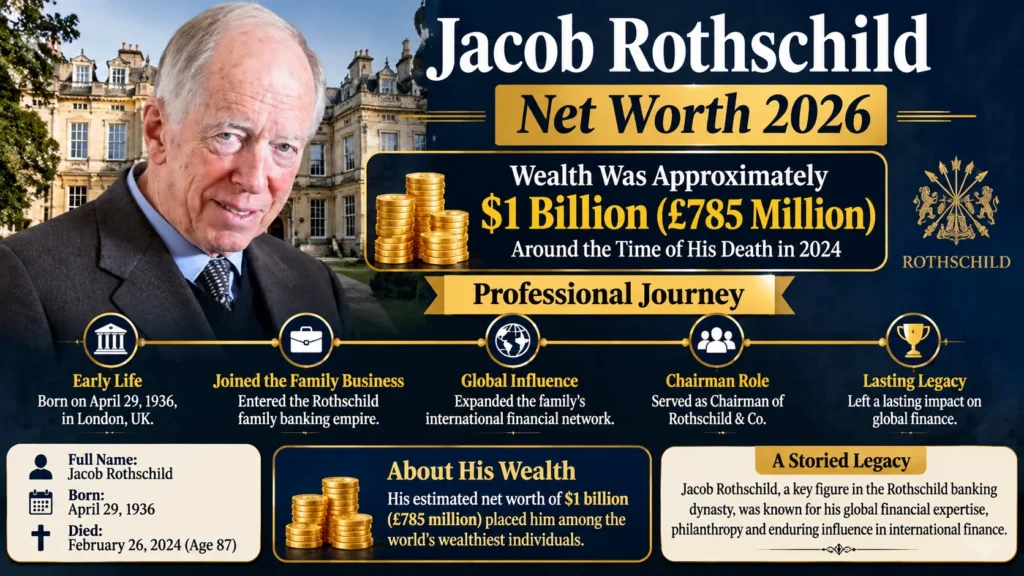
Jacob Rothschild’s reported wealth was approximately $1 billion (£785 million) around the time of his death in 2024, based on estimates associated with the wider Rothschild family’s fortune; his individual estate value remains unverified.
Jacob Rothschild was a British financier, investment manager and philanthropist who built an influential career in international finance. As the 4th Baron Rothschild and a member of the historic Rothschild banking family, he became known for his investment leadership, business ventures and contributions to British cultural institutions.
Interest in Jacob Rothschild’s net worth remains strong because of his family’s financial history and his involvement in major investment businesses. His career included leadership of RIT Capital Partners, co-founding J Rothschild Assurance Group, and holding senior positions in other organisations. These activities helped establish his reputation as one of Britain’s prominent financial figures.
Reports around the time of his death in February 2024 associated his wealth with an estimated $1 billion (£785 million). However, this figure requires an important qualification. The Sunday Times Rich List estimate frequently cited in contemporary reporting placed the wider Rothschild family’s fortune at approximately £825 million. It did not provide a separately verified valuation of Jacob’s individual estate.
Jacob Rothschild died on February 26, 2024, aged 87. Therefore, this 2026 article examines his reported historical wealth, business interests, investment career and financial legacy rather than suggesting that he continues to earn personal income.
Understanding his fortune also requires separating personal net worth from family wealth, company valuations, investment portfolios and charitable assets. This distinction provides a more accurate picture of his financial position and lasting influence.
Bio Data Table
| Category | Details |
| Full Name | Nathaniel Charles Jacob Rothschild |
| Known As | Jacob Rothschild, 4th Baron Rothschild |
| Date of Birth | April 29, 1936 |
| Date of Death | February 26, 2024 |
| Age at Death | 87 years |
| Place of Birth | Berkshire, England |
| Nationality | British |
| Height | Not publicly verified |
| Weight | Not publicly verified |
| Health Conditions | Not publicly verified |
| Religion | Not publicly verified |
| Education | Eton College; Christ Church, Oxford |
| Profession / Industry | Financier, investor, businessman and philanthropist |
| Zodiac Sign | Taurus |
| Marriage Status | Married to Serena Dunn until her death in 2019 |
| Children | Four: Hannah, Beth, Emily and Nat |
| Reported Wealth | Approximately $1 billion (£785 million), with individual valuation unverified |
| Social Media Accounts | Not publicly verified |
| Still Alive | No; died February 26, 2024 |
| Famous For | RIT Capital Partners, St James’s Place, investment management and philanthropy |
Who Was Jacob Rothschild?
Nathaniel Charles Jacob Rothschild was born on April 29, 1936, in Berkshire, England. He belonged to the Rothschild family, a prominent European banking dynasty with a financial history dating back to the eighteenth century.
The Rothschild family established banking businesses across several European financial centres and became influential in international finance. Jacob grew up within this established business environment, but he eventually developed an independent career through investment management and financial services.
He attended Eton College before studying history at Christ Church, Oxford. His education provided a foundation for his professional development and introduced him to an academic environment that extended beyond the financial world.
In 1963, Rothschild joined NM Rothschild & Sons, the family banking business. His early work introduced him to banking operations, financial markets and investment relationships.
However, his career eventually moved beyond the traditional family bank. Differences within the family business contributed to his departure, after which he pursued independent investment and business ventures.
This decision became an important turning point. Rather than relying solely on the family’s established banking operations, he developed his own financial interests and helped build businesses that became significant parts of his professional legacy.
His work in investment management, financial services and corporate leadership later established him as a prominent figure in British business.
Jacob Rothschild Net Worth Overview 2026: Estimated Fortune
Jacob Rothschild’s reported wealth was approximately $1 billion (£785 million) around the time of his death in 2024. This estimate is commonly associated with reporting about the Rothschild family’s financial position, but it should not be interpreted as a verified valuation of Jacob’s individually owned assets.
The Sunday Times Rich List estimate frequently cited in reports following his death placed the wider Rothschild family’s wealth at approximately £825 million in 2023. Media coverage sometimes described this as a family fortune of around $1 billion.
That distinction matters because a family wealth estimate can include interests belonging to several relatives, trusts, companies and other financial arrangements. It does not automatically establish the personal wealth of one family member.
Jacob’s individual fortune was connected to decades of work in investment management, financial services and corporate leadership. He founded Rothschild Investment Trust, later known as RIT Capital Partners, and co-founded J Rothschild Assurance Group, which became St James’s Place.
His career also involved other investments and senior corporate roles. These activities demonstrate substantial financial influence, although the full value of his personal ownership interests has not been publicly established.
Why the $1 Billion Estimate Requires Context
Several factors explain why reported estimates of Jacob Rothschild’s wealth can differ:
- Family wealth: Some reports refer to the combined fortune of the Rothschild family rather than Jacob’s individual holdings.
- Business ownership: The value of a company cannot automatically be attributed to its founder, chairman or former executive.
- Investment portfolios: Assets managed by an investment company belong to the company and its shareholders, not necessarily to one individual.
- Private holdings: Some investments and ownership arrangements may not have public valuations.
- Estate arrangements: Taxes, liabilities, trusts, inheritance and charitable distributions can affect the final value of an estate.
For these reasons, approximately $1 billion (£785 million) is best described as a reported wealth estimate associated with Jacob Rothschild and the wider family fortune. His precise individual net worth at death remains not publicly verified.
Net worth figures are estimates based on publicly available data and may vary.
Net Worth Growth Timeline
A precise year-by-year net-worth timeline is not possible because comprehensive personal wealth valuations are unavailable. However, Jacob Rothschild’s career milestones provide a useful way to understand how his financial influence developed.
Before Fame: 1936–1963
Jacob Rothschild grew up in a prominent banking family and received his education at Eton College and Oxford University.
He entered the financial industry in 1963 by joining NM Rothschild & Sons. His early career focused on banking and financial activities.
During this period, his professional earnings came from his work in finance. His family’s established position provided access to business relationships, but no reliable public record establishes his personal net worth during these years.
Breakthrough Phase: 1971–1988
Rothschild established Rothschild Investment Trust in 1971, creating the foundation for what later became RIT Capital Partners.
The investment trust provided him with an independent platform for managing capital and pursuing opportunities across different markets.
In 1980, he co-founded J Rothschild Assurance Group with Sir Mark Weinberg. The company later became St James’s Place, a major financial advisory and wealth management business.
These ventures expanded his influence beyond traditional banking. His financial position became increasingly connected to business ownership, investment interests and the development of financial services companies.
Peak and Later Years: 1988–2024
Rothschild continued to develop RIT Capital Partners and held its chairmanship for decades. The company became an established investment trust with a diversified portfolio.
He also held senior positions in other organisations, including deputy chairman of BSkyB.
In later years, his professional activities increasingly included investment oversight, philanthropy, cultural leadership and support for charitable institutions.
He retired from the RIT Capital Partners board in 2019 after a long period of leadership. He died in February 2024, aged 87.
His death ended his personal earning years. Subsequent financial developments relate to his estate, inheritance arrangements, family interests and the continuing performance of businesses and institutions associated with his career.
Main Sources of Jacob Rothschild’s Wealth
Jacob Rothschild’s wealth was associated with investment management, financial services, business ownership and other financial interests. His career did not depend on a conventional salary alone.
1. Investment Management and RIT Capital Partners
RIT Capital Partners was one of the most important businesses in Jacob Rothschild’s financial career.
He established Rothschild Investment Trust in 1971 and helped develop it into a listed investment company. The organisation later adopted the RIT Capital Partners name.
The trust invested across different asset classes and markets. Its portfolio included publicly traded companies, private businesses, investment funds and other financial opportunities.
Rothschild served as chairman for decades and played a major role in shaping its investment philosophy.
RIT Capital Partners reported substantial long-term growth during his leadership. Its net asset value increased from approximately £5 million at its establishment to more than £3 billion by the time he retired from the board in 2019.
This growth demonstrates the scale of the investment organisation he helped build. However, the trust’s net asset value was not Jacob’s personal net worth. It represented the value of the company’s investments for its shareholders.
His individual financial benefit would have depended on his actual shareholding, distributions, transactions and other personal financial interests.
2. St James’s Place and Financial Services
In 1980, Rothschild co-founded J Rothschild Assurance Group with Sir Mark Weinberg.
The company later became St James’s Place, a major British wealth management and financial advisory business.
St James’s Place developed a business model focused on financial planning, investment advice and wealth management. Its expansion established it as a recognised name in the UK financial services industry.
Co-founding a financial company can create wealth through ownership interests, shareholdings and business growth. However, the company’s total revenue and market value should not be confused with the personal wealth of its founders.
The exact value of Jacob Rothschild’s individual ownership interest at different stages is not publicly verified.
3. Global Asset Management
Rothschild also participated in the development of Global Asset Management, an investment management business.
His involvement reflected his wider interest in professional asset management and financial markets.
Investment management companies can generate revenue through management fees and other services. Their owners and investors may benefit from business growth, distributions and changes in equity value.
However, without complete ownership and transaction records, it is not possible to determine exactly how much this venture contributed to his individual fortune.
4. Corporate Leadership and Board Positions
Rothschild held several senior corporate positions during his career.
One notable role was deputy chairman of BSkyB, where he served until 2008. He also participated in other financial and business organisations.
Senior corporate roles may provide board compensation, advisory fees or share-based benefits. They can also strengthen professional relationships and create opportunities for further investments.
However, his cumulative income from these positions is not publicly verified.
5. Private Investments and Ownership Interests
Rothschild’s career involved investments across different sectors and financial markets.
Private investments can generate returns through dividends, business expansion, acquisitions and the eventual sale of ownership interests.
The value of such investments depends on the amount invested, ownership percentage, market conditions and costs.
His complete personal investment portfolio was not publicly disclosed, so assigning a precise value to this category would be speculative.
Business Strategy Behind the Wealth
Jacob Rothschild’s financial success was associated with long-term investment thinking, business development, diversification and professional relationships.
Long-Term Investment Philosophy
His leadership of RIT Capital Partners reflected an emphasis on long-term capital growth and diversification.
A diversified investment portfolio can reduce dependence on one market or industry. It also provides exposure to different sources of potential returns.
Rothschild’s investment approach allowed the trust to participate in opportunities across public markets, private companies and other asset classes.
Independent Business Development
Although he came from a prominent banking family, Rothschild developed financial ventures outside the traditional family bank.
His work with RIT Capital Partners and St James’s Place helped establish an independent business identity.
This approach allowed him to participate in investment management and financial services through organisations with their own business models and shareholder structures.
Partnerships and Professional Networks
Rothschild worked with experienced business figures and maintained relationships across financial institutions and corporate organisations.
These connections helped him establish companies, identify investment opportunities and participate in major business decisions.
In finance, professional networks and long-term relationships can provide access to opportunities that may not be available through public markets alone.
Diversification and Ownership
His interests extended across investment management, financial services and other business activities.
Diversification can help investors balance risk and pursue growth across different markets. However, it cannot eliminate the possibility of losses or changes in asset values.
His career demonstrates how investment expertise and business ownership can create long-term financial influence, although the precise contribution of each venture to his personal estate remains uncertain.
Awards and Achievements and Their Financial Impact
Jacob Rothschild received recognition for his contributions to finance, culture, heritage and philanthropy.
Order of Merit
Rothschild received the Order of Merit in 2002. The honour recognised his significant contributions to public life and other fields.
It strengthened his reputation as a prominent figure in British society, although the award itself did not directly establish a financial benefit.
Knight Grand Cross of the Order of the British Empire
He received the Grand Cross of the Order of the British Empire, commonly known as GBE.
This recognition reflected his contribution to public and cultural life.
Commander of the Royal Victorian Order
Rothschild also received the Commander of the Royal Victorian Order.
This honour formed part of his wider record of public recognition.
National Gallery Leadership
He served as chairman of the trustees of the National Gallery from 1985 to 1991.
His involvement demonstrated his commitment to British art and cultural heritage.
National Heritage Memorial Fund
Rothschild also chaired the National Heritage Memorial Fund and the Heritage Lottery Fund.
These roles involved supporting the preservation of important historical and cultural institutions.
His achievements strengthened his public reputation and professional influence. Recognition can help build credibility and relationships, but it should not be treated as a direct measure of personal wealth.
Assets and Lifestyle
Jacob Rothschild’s position within a prominent British family and his long financial career attracted public interest in his property, investments and lifestyle.
However, a responsible financial assessment must distinguish between personal assets, family properties, company holdings and charitable institutions.
Real Estate and Waddesdon Manor
Waddesdon Manor is closely associated with the Rothschild family’s history.
The historic property is managed through the Rothschild Foundation and operates as an important cultural and heritage institution.
Its connection with the family does not mean the entire property should be counted as Jacob Rothschild’s personal asset.
Ownership, charitable management and private financial interests are separate categories.
Spencer House
RIT Capital Partners is headquartered at Spencer House in London. The company acquired a long leasehold interest in the historic property in 1986.
Spencer House has architectural and business significance and reflects the company’s connection with London’s historic property market.
However, the property interest belongs to the company and should not automatically be included in Jacob Rothschild’s personal estate.
Cars and Luxury Possessions
There is no reliable, comprehensive public inventory of Jacob Rothschild’s personally owned cars, watches, jewellery or other luxury possessions.
Their ownership and values are not publicly verified.
Financial and Business Assets
Rothschild’s career involved investment businesses, shareholdings and financial interests.
RIT Capital Partners and St James’s Place represent major parts of his business legacy. However, their total corporate values cannot be attributed to him personally.
The precise value of his individual shareholdings, private investments and other assets at death remains not publicly verified.
Net Worth Comparison With Peers and the Financial Industry
Comparing Jacob Rothschild with other prominent financiers requires caution because wealth estimates may include different categories of assets.
Some figures represent individual fortunes, while others combine the assets of family members, trusts or businesses.
Rothschild’s career placed him among Britain’s influential investment figures. His work involved establishing financial companies, managing investment capital and participating in major corporate organisations.
Rothschild Family Wealth
The Rothschild family has a long history in European banking and finance. The Sunday Times Rich List estimate cited in reporting around Jacob’s death placed the wider family’s wealth at approximately £825 million in 2023.
This figure provides context for the scale of the family fortune in public reporting. It does not establish Jacob’s individual wealth.
Other Financial Dynasties
Comparisons with other established financial families can be misleading because different families use different ownership structures.
Some assets may belong to individual relatives, while others sit within companies, trusts or charitable foundations.
A family’s combined wealth can also change through inheritance, donations, business transactions and investment performance.
For this reason, a precise ranking of Jacob Rothschild’s personal fortune against other financiers is not publicly verified.
His influence in investment management and British business is better documented than his exact personal wealth ranking.
Controversies, Challenges and Financial Risks
Jacob Rothschild’s public career was primarily associated with investment management, business leadership and philanthropy. Any discussion of financial controversy should rely on documented evidence rather than unsupported claims.
His businesses nevertheless operated in industries exposed to several financial risks.
Investment Market Volatility
Investment trusts hold assets whose values can rise or fall with market conditions.
Interest rates, inflation, economic growth, company performance and investor confidence can all affect investment valuations.
RIT Capital Partners’ diversified strategy provided exposure to different markets, but diversification could not eliminate investment risk.
Business Ownership Complexity
Financial companies often contain multiple shareholders, subsidiaries, investment vehicles and ownership arrangements.
These structures make it difficult to calculate the personal wealth of founders or former executives.
A company’s assets belong to the company and its shareholders collectively, rather than automatically belonging to one individual.
Inheritance and Estate Planning
The transfer of wealth after death can involve inheritance arrangements, taxes, trusts, liabilities and charitable commitments.
These factors can affect the final value of an estate and the distribution of assets among beneficiaries.
The complete details of Jacob Rothschild’s personal estate distribution are not publicly verified.
Public Misconceptions About Family Wealth
The Rothschild name has attracted public attention and misinformation over many years.
Some online claims have attributed enormous financial power to the family without credible supporting evidence.
Fact-checking organisations have challenged claims that the family controls central banks or the global economy. Such claims should not be treated as reliable descriptions of the family’s financial position.
A factual assessment should rely on documented business interests, credible financial reporting and official records.
Philanthropy and Social Impact
Philanthropy was an important part of Jacob Rothschild’s public life.
He supported cultural institutions, education, environmental causes, heritage preservation and charitable initiatives.
Rothschild Foundation
Rothschild served as chairman of the Rothschild Foundation, which supports cultural, educational, environmental and community activities.
The foundation also plays an important role in the preservation and management of Waddesdon Manor.
After his death, his daughter Hannah Rothschild succeeded him as chair.
The foundation’s continuing activities form an important part of his charitable legacy.
Yad Hanadiv
Rothschild also served as president of Yad Hanadiv, the Rothschild Foundation in Israel.
The organisation supports initiatives involving education, environmental development, academic excellence and civil society.
His work with the foundation reflected his commitment to charitable and cultural projects in Israel.
Arts and Heritage
Rothschild supported Britain’s cultural sector through leadership positions at the National Gallery and heritage organisations.
He also contributed to the preservation and development of important cultural institutions.
His involvement connected private philanthropy with public heritage projects.
Environmental and Educational Causes
His philanthropic interests extended beyond art and heritage. He also supported environmental and educational initiatives.
The total value of his personal lifetime charitable donations is not publicly verified. However, his leadership of major philanthropic organisations is well documented.
How Jacob Rothschild Built Influence Outside Traditional Banking
Jacob Rothschild’s career extended beyond his early position at NM Rothschild & Sons.
He developed an independent investment business, co-founded a financial services company and participated in corporate leadership.
His involvement in the arts and philanthropy also strengthened his public influence.
Rather than relying on one professional activity, he developed relationships across finance, business, culture and charitable institutions.
His work with RIT Capital Partners demonstrated his ability to build an investment organisation with a long-term institutional identity.
His involvement with St James’s Place showed another side of his financial career through the development of a wealth management business.
Outside finance, his leadership of cultural and charitable organisations helped establish a lasting public legacy.
These activities contributed to his historical significance, although they should not be treated as additional personal income streams without supporting financial records.
Future Net Worth Projection: Jacob Rothschild’s Estate and Legacy
Jacob Rothschild died in February 2024, so he cannot generate new personal earnings or experience future personal net-worth growth.
A conventional future net-worth projection would therefore be inappropriate. The relevant financial discussion concerns his estate, inherited interests, family wealth structures and the continuing institutions associated with his name.
The value of an estate can change after death through investment performance, asset sales, taxes, inheritance arrangements, charitable distributions and other financial decisions.
His investment legacy also continues through institutions and businesses that he helped establish. RIT Capital Partners remains an investment company, while the Rothschild Foundation continues its charitable and cultural work.
However, the performance of these organisations does not automatically increase the value of Jacob’s personal estate.
Any future financial assessment should distinguish between the value of his estate at death, the wealth of surviving family members and the assets held by independent companies or charitable foundations.
Estate and Legacy Timeline
| Period | Financial Focus | What It Means |
| 2024 | Death and estate administration | Personal earnings ended; estate arrangements became relevant |
| 2025 | Family and institutional continuity | Existing business and charitable interests continued |
| 2026 | Estate and investment legacy | Individual estate value remains not publicly verified |
| 2027 onward | Family wealth and institutional performance | Asset values may change, but do not represent new personal earnings |
These are legacy milestones, not numerical estimates of future personal net worth. No reliable public information supports a precise projection of Jacob Rothschild’s individual estate for future years.
FAQs
1. What was Jacob Rothschild’s net worth?
Reports estimated his wealth at approximately $1 billion (£785 million), although his personal estate value remains unverified.
2. When did Jacob Rothschild die?
Jacob Rothschild died on February 26, 2024, at the age of 87.
3. How did Jacob Rothschild make his money?
He built his wealth through investment management, financial services, business ownership and corporate leadership.
4. Was Jacob Rothschild a billionaire?
Some reports estimated his wealth at around $1 billion, but his personal billionaire status remains unverified.
5. Was Jacob Rothschild the founder of RIT Capital Partners?
Yes. He founded Rothschild Investment Trust in 1971, later renamed RIT Capital Partners.
6. Who inherited Jacob Rothschild’s wealth?
He was survived by four children: Hannah, Beth, Emily and Nat. The exact inheritance distribution remains undisclosed.
Conclusion
Jacob Rothschild was a prominent British financier known for his work in investment management, banking, and philanthropy. He helped establish Rothschild Investment Trust, develop RIT Capital Partners, and co-found J Rothschild Assurance Group, later known as St James’s Place.
Reports estimated his wealth at approximately $1 billion (£785 million) around the time of his death. However, the widely cited £825 million Sunday Times figure referred to the wider Rothschild family, not his independently verified personal estate.
Net worth figures are estimates based on publicly available data and may vary.